
Building the Digital Brain Behind RoBee
Humanoid robots don’t become capable by accident. Behind every reliable, deployable system is an engineering process that demands iteration, precision, and increasingly, simulation. When Oversonic Robotics set out to accelerate the development of RoBee, their humanoid platform designed for industrial and medical environments, they understood this clearly. Hardware alone wouldn’t get them there fast enough.
That’s what brought them to FS Studio.
Oversonic had already made serious progress. RoBee’s hardware architecture was advancing rapidly, but the team recognized a growing gap between what they could build and what they could safely test. Validating new behaviors, confirming sensor performance, and preparing the robot for AI development all required a digital environment rigorous enough to trust and one where experimentation wouldn’t come at the cost of physical hardware or project timelines.
The first conversations weren’t about tools or timelines. They were about the robot itself.
FS Studio assigned a dedicated project team that included a full-time simulation developer, a technical artist, and a fractional project manager, and started by understanding RoBee from the ground up: its locomotion design, its sensor dependencies, and the operational contexts it was being built for. Weekly technical working sessions and a maintained product backlog kept development aligned with Oversonic’s priorities at every stage. That investment in structure and communication shaped everything that followed.
The technical execution was demanding. In the first phase of work, FS Studio reconstructed RoBee inside NVIDIA Isaac Sim with the fidelity that real engineering requires. Geometry was simplified and meshes optimized for simulation performance. Every joint was configured with accurate stiffness, damping, and range-of-motion values. The robot’s Mecanum wheel system was modeled for physical accuracy, enabling realistic mobility testing under simulation conditions. This wasn’t a rendering, it was a working mechanical replica.
The sensor integration matched that standard. RoBee operates with a dense, sophisticated sensor stack, and every component was brought into the simulation: two 2D LiDARs, two 3D LiDARs, nine RGB-D cameras, and a Robotiq 6-axis force-torque sensor. Each was connected through ROS 2, enabling real-time data streaming that directly mirrors the physical system. Engineers could now test sensor behavior, tune inputs, and validate integration without touching the hardware.
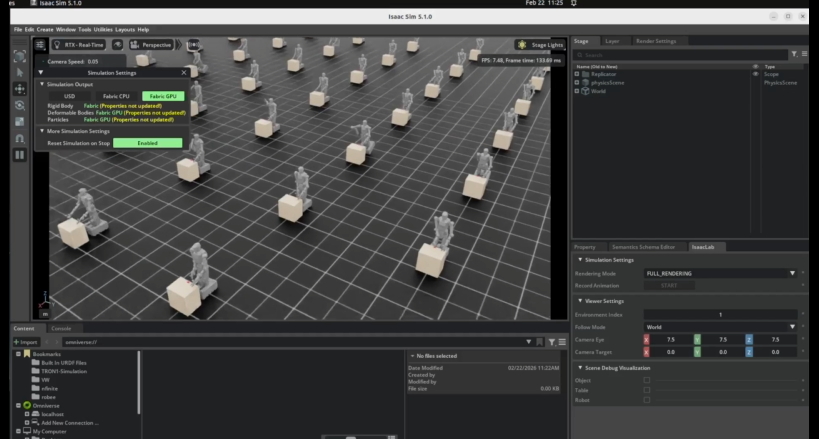
The second phase extended that foundation into AI readiness. Using NVIDIA Isaac Lab, FS Studio configured a reinforcement learning environment built around RoBee’s architecture. We looked at observation spaces, action structures, reward frameworks, and full documentation for Oversonic’s team to begin running their own training workflows independently. The deliverable wasn’t a trained policy. It was something more strategically valuable: infrastructure that Oversonic owns and controls entirely.
Enhancing RoBee’s Capabilities
This project represents the first phase of an ongoing relationship. As RoBee moves closer to real-world deployment in industrial and medical settings, FS Studio will continue supporting Oversonic’s development, from expanded AI training workflows to application-specific simulation scenarios. The foundation built here was designed with that future in mind.
The results speak for themselves. Vincenzo Latino, R&D Engineering Manager at Oversonic, put it directly:
“Working with FS Studio has been an excellent experience. They helped us develop a model that is incredibly close to the real one, which will be instrumental for our training sessions and the development of new applications. Their expertise and support have been invaluable to our progress.”
What made this work wasn’t just technical competency; it was the right division of expertise. Oversonic brought deep, firsthand knowledge of RoBee and the demanding environments it’s being built to operate in. FS Studio brought the simulation, digital twin, and AI infrastructure knowledge to translate that into a development platform worth using.
RoBee’s path to factories and hospitals runs through rigorous engineering. That engineering now has the infrastructure it deserves.
What FS Studio Delivered
Digital Twin Development High-fidelity reconstruction of RoBee inside NVIDIA Isaac Sim, including optimized geometry, articulated joints with accurate physical parameters, and Mecanum wheel dynamics modeled for realistic simulation testing.
Sensor Suite Integration Full integration of RoBee’s sensor stack via ROS 2, including 2x 2D LiDAR, 2x 3D LiDAR, 9x RGB-D cameras, and a Robotiq 6-axis force-torque sensor that enabled real-time data streaming that mirrors the physical robot.
Reinforcement Learning Environment Configuration of an NVIDIA Isaac Lab RL environment scoped for RoBee, with observation and action spaces, reward structure, and training configuration fully documented and ready for Oversonic’s team to run independent experiments.
Project Management Dedicated project management throughout, including weekly customer calls, iterative design and technical working sessions, and a maintained product backlog to keep every milestone on track.