
A Simulation-Driven Pilot for Workforce Integration
Why They Came to FS Studio
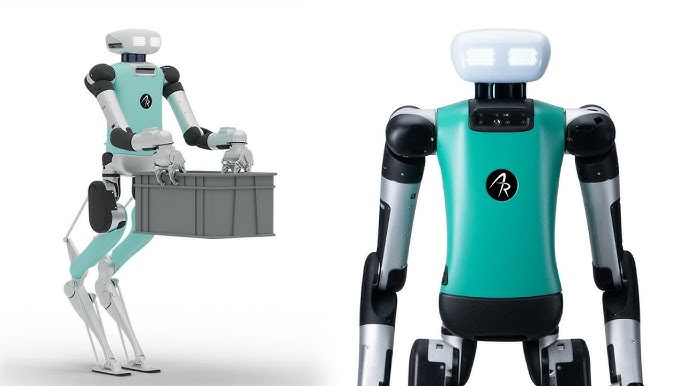
The client was not starting from zero. Their organization had already evaluated Agility Robotics’ Digit, one of the most advanced humanoid robots available for industrial deployment, and was genuinely convinced of its potential. Digit performed as expected in controlled test conditions. Technical feasibility was not the issue.
The issue was internal alignment.
Leadership needed to build the business case to justify deployment investment across an active industrial facility. That meant answering a specific, high-stakes question for their stakeholders. Not “Can a humanoid robot work in a facility like ours?” but “Can Digit work in our facility, our floor plan, our infrastructure, our operational constraints?”
Without a physical pilot, which would require significant time, coordination, and capital, they had no credible way to answer that question. Conceptual demos and vendor materials were not sufficient to move decision-makers. They needed something more rigorous: a simulation of Digit grounded in their actual environment, producing data and visuals that could withstand scrutiny.
FS Studio was engaged to deliver exactly that.
The Challenge
Three core requirements shaped the project scope:
Contextual Accuracy: The simulation had to place Digit inside the client’s real facility, not a generic industrial template. Stakeholders would immediately recognize their own environment, and any disconnect would undermine credibility.
Quantifiable Outputs: The deliverable needed to go beyond visual storytelling. The simulation had to generate behavioral and motion data on Digit’s performance that could be referenced in planning and investment discussions.
Stakeholder Persuasion: The final output needed to be compelling enough to shift internal consensus, translating a promising but abstract technology into a concrete, and investable deployment path.
The Solution
FS Studio built a high-fidelity simulation environment in NVIDIA Omniverse, importing the client’s actual facility layout as the operational context and modeling Digit’s physical and locomotion characteristics with precision. Every element of the workflow was designed to produce outputs that were technically defensible and visually precise.
The simulation development process included:
- Acquisition and analysis of reference footage documenting Digit’s real-world locomotion and gait mechanics
- Import of the client’s facility geometry into Omniverse to accurately replicate navigation constraints and environmental conditions
- Development of storyboards and movement sequences reviewed and approved iteratively with the client
- Physics-based locomotion simulation modeling Digit’s gait, ground interaction, and dynamic stability
The project team comprised a Senior 3D Modeler/Animator, Senior Technical Artist, Fractional Simulation Lead, and a dedicated Project Manager. Delivery followed an agile workflow with weekly client syncs, structured feedback cycles, and a centralized product backlog for full technical traceability.
Simulation Data Outputs
The primary deliverable was a 10-second, high-fidelity animation of Digit navigating from Point A to Point B within the client’s facility. The underlying simulation environment generated a comprehensive set of technical data outputs:
- Joint Position and Velocity Data — Per-degree-of-freedom tracking across Digit’s limbs for gait analysis, stability assessment, and efficiency evaluation
- Foot Contact and Ground Reaction Forces — Contact point measurement critical for stability modeling and fall-prevention validation
- Balance and Center of Mass Tracking — Dynamic stability monitoring across facility geometry including uneven surfaces and directional changes
- Sensor Fusion Outputs — Simulated LiDAR, IMU, and camera feeds providing the data foundation for future obstacle avoidance and perception integration
- Pathfinding and Navigation Data — Real-time trajectory planning evaluation against the actual facility floor plan
- Environmental Interaction Logs — Documentation of how Digit’s sensors and body respond to facility geometry, lighting conditions, and potential obstructions
These data outputs are directly applicable to deployment planning, safety validation, and operational integration design.
Results
The final simulation exceeded the client’s stated objectives across all three dimensions of the engagement:
Stakeholder Alignment Achieved: Decision-makers watched Digit operating within their own facility for the first time. The specificity of the environment, their layout and their operational context produced the credibility that generic demos could not. Investment discussions moved from exploratory to directional.
Deployment Planning Initiated: Simulated sensor placement and pathfinding data generated actionable insight into viable use cases for Digit, including autonomous delivery, facility inspection, and collaborative labor alongside human workers.
Strategic Foundation Established: The simulation became the technical baseline for a broader automation strategy, giving the client the internal alignment and data foundation necessary to move from pilot to phased deployment.
Conclusion
This engagement demonstrated that simulation is not a preparatory step toward robotics deployment, it is a deployment accelerator. By grounding the simulation of Digit in the client’s actual facility and extracting rigorous operational data, FS Studio reduced internal uncertainty, compressed the alignment timeline, and gave the client a credible basis for investment.
The robot was ready. The question was whether the organization was. Simulation answered that question.
Driven by simulation. Validated by data. Designed for action.