
From Data Collection to Data Creation: Why Simulation is the New Lab
As the demand for advanced analytics rises, synthetic data plays a crucial role in bridging this gap.
In the world of computer vision, there is a recurring ghost in the machine: the gap between “working” and “working in the real world.”
This is where synthetic data can provide a virtual environment to enhance and validate these models.
We recently partnered with a global logistics leader that didn’t come to us because something was broken. Their systems were sophisticated. Their models could detect packages. Their teams had already invested millions in computer vision. On paper, everything was moving in the right direction.
But operations don’t run on paper.
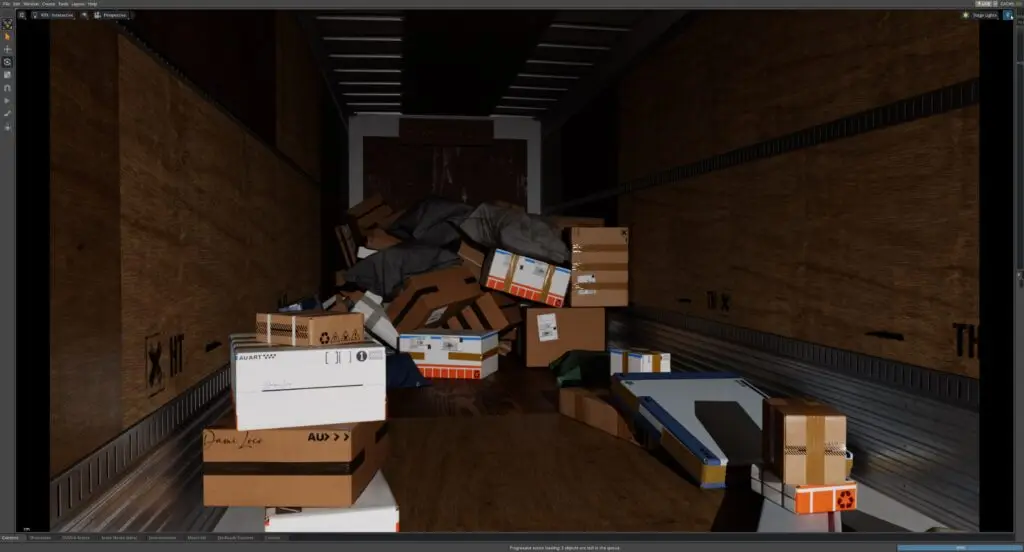
Inside a delivery trailer at 3:00 AM, things fall apart quickly. Lighting shifts as the sun rises. Packages aren’t neatly arranged; they are stacked, crushed, or partially hidden. Materials like shrink-wrap or polished metal reflect light in unpredictable ways. A model that performs with 99% accuracy in a clean lab starts to struggle the moment it’s placed into the grit of a live facility.
That was the gap we needed to bridge. Not whether their models worked, but whether they would continue to work when the environment stopped cooperating.
This is where synthetic data becomes essential.
What is Synthetic Data? (The Power of the Digital Twin)
To understand how we solved this, you have to understand the shift from collecting data to generating it.
Traditionally, training AI is a manual, grueling process. You take thousands of real-world photos, hire people to draw boxes around every object (labeling), and feed them to the machine. It’s slow, expensive, and you are limited by what you can catch on camera. If you need a photo of a crushed box under a tilted pallet in low light, you have to wait for it to happen—or stage it.
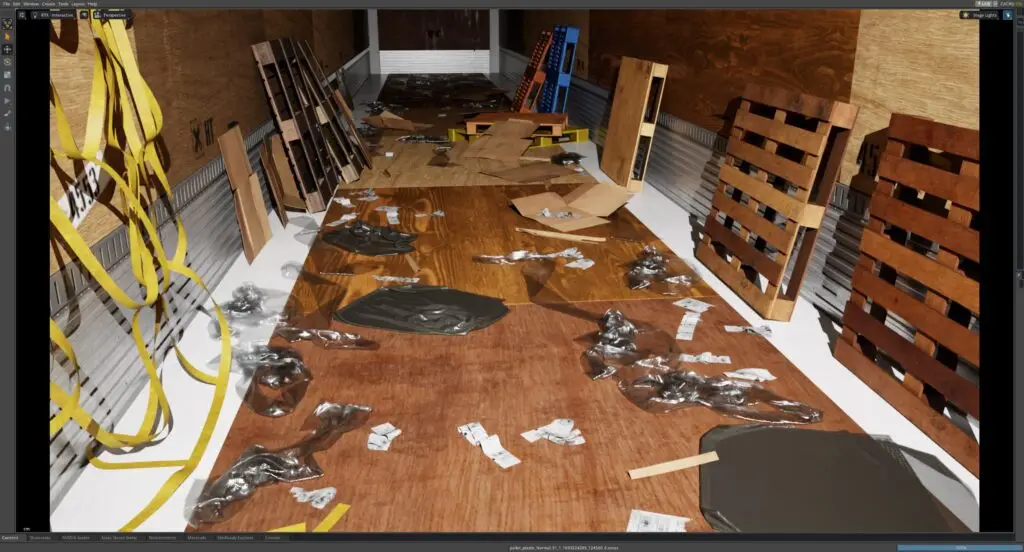
Synthetic data flips the script. Instead of taking photos of the world, we build a “Digital Twin” of the environment. Using tools like NVIDIA Omniverse Replicator and Isaac Sim, we create a hyper-realistic 3D simulation that obeys the laws of physics.
In this virtual sandbox, we don’t wait for a rare edge case to happen; we manufacture it. We can tell the computer: “Show me a crushed exhaust manifold, hidden under a collapsed bag, in harsh directional light, 10,000 different ways.” The computer then generates those images, perfectly labeled, in seconds.
Inside the Build: How We Bridged the Gap
To make this work for our logistics partner, we had to move beyond generic simulation. We built a custom technical stack designed specifically for the chaos of a trailer.
1. The Physics of the Environment
We didn’t just build a “scene”; we built a functional environment. We created high-fidelity digital twins of various trailer sizes and spatial constraints. Most importantly, we focused on radiometry—modeling exactly how light behaves as it enters the trailer at different times of day, reflecting off the corrugated metal walls and pooling in deep, dark corners.
2. High-Fidelity Asset Creation
We focused on the “nightmare” items that typically cause computer vision to fail. We didn’t use idealized shapes; we modeled the physical properties of:
- Collapsible “Forever Bags” that change their silhouette every time they move.
- Reflective Paint Cans that create blinding glints of light.
- Irregular Geometries like exhaust manifolds and dense barbells.
- Pallets that create complex, layered occlusions.
3. The Scalable Automation Wrapper
The real “magic” happened in the workflow. We built a custom Python-based wrapper that automated the entire dataset creation process. This allowed the team to essentially “order” a dataset. Need 5,000 images of an empty trailer? 10,000 images of heavy clutter? The system could generate, label, and export these variations systematically.
4. The Collaborative Feedback Loop
This wasn’t a “set it and forget it” project. We met weekly with their engineering team to review progress. We refined the textures, adjusted the lighting physics, and tweaked object behaviors based on their real-world expertise. This ensured that the synthetic data wasn’t just “pretty”—it was operationally accurate.
The Result: From Accuracy to Consistency
As the synthetic data was integrated into the training pipeline, the model’s behavior transformed. It wasn’t just about a higher detection score; it was about reliability.
- Low-light detection became sharp and reliable.
- False positives in cluttered or messy scenes dropped significantly.
- Model variability was reduced, meaning the system performed predictably whether it was facing a perfectly stacked pallet or a trailer full of “edge cases.”
Who Else Benefits? (The “Sizzle” Beyond Logistics)
Logistics is just the beginning. As we move into 2026, synthetic data is becoming the backbone of any industry where the cost of failure is high and data is hard to get.
- Manufacturing & Robotics: Train robotic arms to handle new parts or detect microscopic defects before the hardware ever touches the floor.
- Autonomous Vehicles & Agriculture: “Experience” life-or-death edge cases millions of times in total safety.
- Healthcare & Privacy: Create “digital patients” to train diagnostic AI while staying 100% compliant with privacy laws.
Why Weren’t We Doing This Sooner?
There is a moment in these projects where the question quietly changes. It’s no longer, “Does this work?” It becomes, “Why weren’t we doing this sooner?”
The traditional way to improve AI is to wait: wait for more data, wait for the right lighting, wait for the world to cooperate. Synthetic data allows you to stop waiting. It gives you the power to create the reality your model needs to learn.
Because in the real world, the world never cooperates. But in the simulation, you’re the one in control.