
By Bobby Carlton
On July 28, 2026, the FCC added foreign-produced advanced robotic devices to its Covered List. Most coverage called it a ban on Chinese humanoid robots. The real story is bigger: robotics just became strategic infrastructure, and every American company betting on robots to boost productivity now depends on how fast domestic capacity can scale. This is critical as we explore the implications of The FCC Robot Ban Explained.
That scaling question is not really about hardware. Before any robot delivers ROI on a factory floor or in a warehouse, it has to be trained, and the economics of training live in simulation: thousands of virtual robots failing safely in parallel, learning in hours what would take months and millions of dollars to learn on physical hardware. That training layer is where we work at FS Studio. And as a US-based company, we sit inside the same domestic robotics stack this policy is designed to grow. If the goal is reshoring American robotics, the layer where robots learn to work needs to be American too.
Here are some facts.
Fact 1: It covers more than humanoids
The rule covers mobile humanoids, quadrupeds, and autonomous mobile robots over 4.4 pounds that include sensing, networking, and control software. The definition is broad enough to reach robotic vacuums, pool cleaners, and lawn mowers. Fixed factory arms fall outside the mobile-robot definition. If it moves, senses, and connects to a network, it is likely in scope.
Fact 2: The rule is officially country-neutral
Despite the “China ban” framing, the FCC describes the action as country neutral, with coverage determined by place of production under the Buy American test. A robot built in Europe or Japan faces the same standard. In practice, the impact lands hardest on China, which produces roughly 85 percent of the world’s humanoids.
Fact 3: Assembly location is not enough
The test is where the parts come from, using the federal Buy American standard for domestic component cost. A humanoid assembled in a US facility can still fail if most of its actuators, sensors, and batteries are manufactured abroad. This is supply chain policy, not just import policy.
Fact 4: Existing robots are grandfathered, with a deadline attached
Previously authorized models remain legal to import, sell, and use, with security and firmware updates allowed through at least January 1, 2029. Research labs keep what they have. And here is the detail almost nobody reported: Unitree cleared its entire current lineup through FCC certification weeks before the decision, with the R1 authorized June 22 and the H2 and A2 on June 30. Those grants stand. The dividing line is authorization status, not release date.
Fact 5: There is an escape hatch, and it runs through the Pentagon
Covered new models cannot receive equipment authorization unless the Department of War grants Conditional Approval, a mechanism designed to let manufacturers keep selling while they onshore production. How long those reviews take is still an open question.
Fact 6: This is part of a pattern, and components may be next
The robot addition follows the December 2025 restriction of foreign-produced drones and the March 2026 addition of foreign-produced routers. The supporting materials for the robot rule specifically discuss sensors, actuators, and batteries. The perimeter keeps expanding.
Fact 7: The capacity gap is the real story
The US is walling off the dominant supplier before building the capacity to replace it. Of the roughly 13,300 humanoids shipped globally in 2025, Unitree and AGIBOT each shipped over 5,000. The top US companies shipped in the hundreds. The US leads the world in robot learning research and embodied AI capital, but ships roughly 1/36th the humanoid volume of China’s leading OEMs.
Demand is not the problem. North American companies ordered 36,766 robots worth $2.25 billion in 2025, the sixth straight quarter of order growth, and 2026 is widely seen as the year humanoid pilots convert to contracts.
Why simulation becomes essential, not optional
If American robotics companies have to scale fast, simulation stops being a nice-to-have for one simple reason: the math of real-world training does not work.
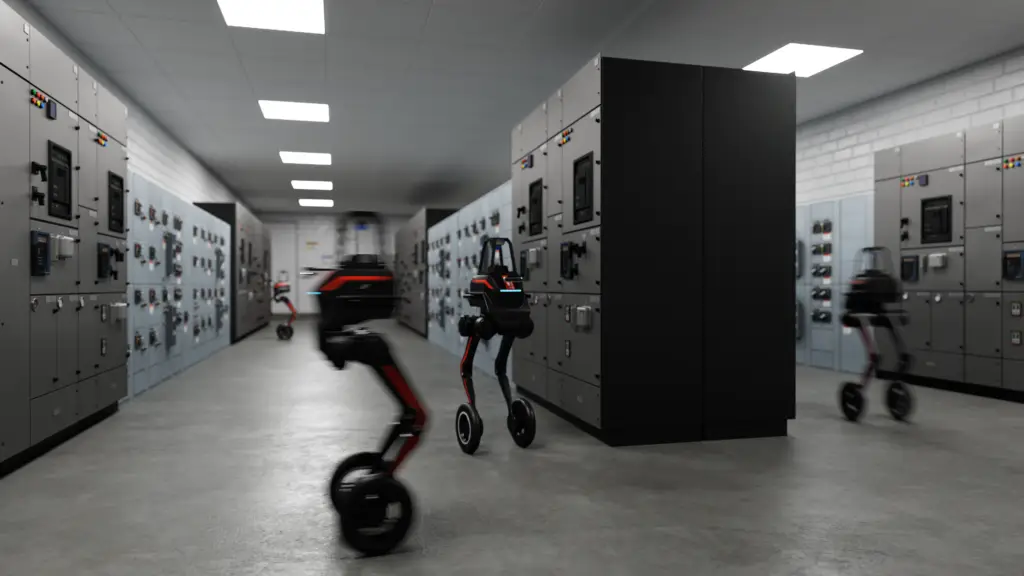
A humanoid learning only in the physical world learns at physical-world speed, one robot, one environment, one failure at a time, with every mistake costing hardware, downtime, or safety incidents. In simulation, that same robot runs thousands of parallel instances, fails safely millions of times, and encounters edge cases that might take years to surface on a real floor. NVIDIA’s Isaac Lab, used by Agility Robotics, Boston Dynamics, and 1X among others, compresses months of robot training into hours. This is not a future technique. It is how every serious humanoid program already works.
There is a second reason, specific to this moment. Robot learning has a data problem: there is no internet-scale corpus of physical interaction data the way there was text for language models. That data has to be manufactured, through simulation, synthetic data, teleoperation, and egocentric video. Deployed fleets generate real-world training data, and US companies shipping in the hundreds cannot match Chinese fleet volume with hardware alone. The training layer is how a smaller fleet learns like a bigger one.
And a third: the ban itself makes domestic simulation capacity strategic. If components land on a future Covered List, hardware iteration gets slower and more expensive, which makes validating designs virtually before committing to physical builds even more valuable. Digital twins let deployment planning start before a single robot arrives. Sim-to-real pipelines mean the robot that shows up on day one already has millions of hours of practice in a virtual copy of the building it is standing in. For the companies buying robots, that is the ROI case in one sentence: less downtime, fewer failed pilots, faster time to productive work.
This is the work we do at FS Studio. We build physics-accurate simulation environments, digital twins, and synthetic data pipelines for robotics teams, including humanoid HRI simulation for U.S. based Agility Robotics, digital twin work for Waymo, and Isaac Sim development for humanoid maker Oversonic Robotics out of Italy. Across every serious robotics program we touch, the pattern is consistent: the teams that scale are the teams that train in simulation first. The policy conversation is about hardware. The deployment reality is decided in the training layer.
What this means
The ban is not a wall. It is a filter with a deadline. Existing robots keep running, new foreign models face a Pentagon-gated approval process, and the component supply chain is likely next. For American robotics, the window is open, but a window is not a workforce, and a ban is not a factory. The race is whether US capacity, hardware and training layer alike, can scale before the window closes.
The best time to build American robotics capability is now. That includes the layer nobody sees: the one where robots learn to work before they ever show up for the job.